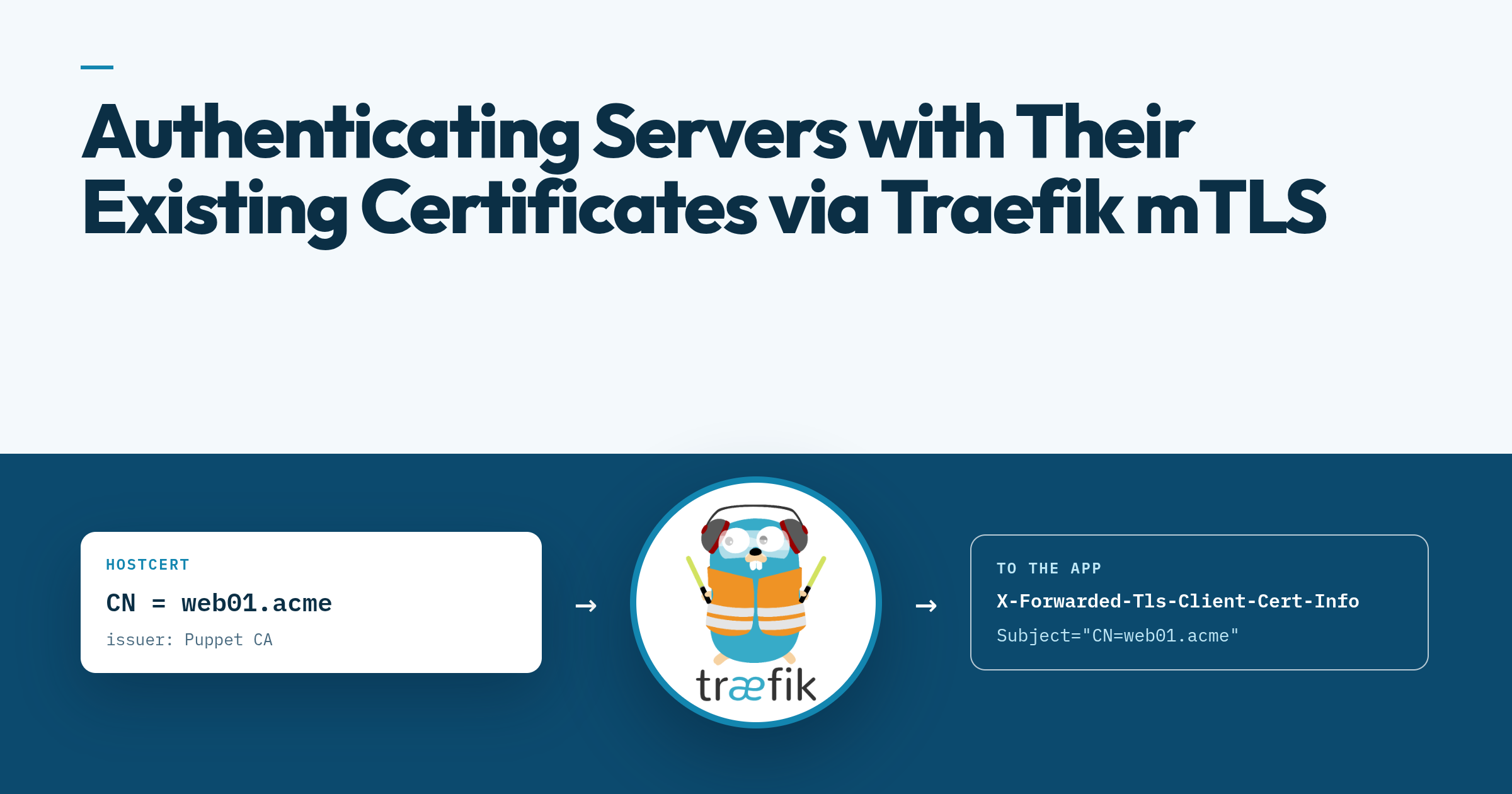
Every Linux server I manage ships metrics to a Prometheus in a Kubernetes cluster and calls a API in the same cluster. Both endpoints sit behind Traefik on a public hostname. The usual answer to how a server proves who it is to endpoints like these is a token per host, written into a config file by configuration management, stored somewhere central, rotated when someone remembers. The token is a second identity for a machine that already has one.
It already has one because every one of those servers runs a Puppet (OpenVox) agent, and the Puppet CA signed a certificate for each host the day it enrolled. The subject is the host’s certname. The key never leaves the machine. Issuing that certificate, putting it on the disk and keeping it current is already part of how the fleet is managed, for reasons that have nothing to do with my API. The hard parts of mTLS already belong to something else.
So the servers authenticate with that certificate. Traefik trusts the Puppet CA, the Ingresses that only servers should reach require a client certificate, and a middleware hands the certificate’s CN to the backend as a header. Most of what follows is about the one decision inside that, which clientAuthType goes where, and about the way it failed on me: a CA bundle that was a hand-made snapshot, and a Puppet CA that moved on without it.
Puppet is the CA here because it is what I run. Anything that already issues a certificate per host fits the same shape: step-ca, Vault PKI, SPIFFE, Teleport host certificates, a corporate PKI. If a key pair and a CA-signed certificate are already on every machine for some other reason, this post applies.
The certificate is already on the disk
A Puppet agent keeps its credentials under /etc/puppetlabs/puppet/ssl. Three settings name the files, and puppet config print resolves them:
$ puppet config print hostcert hostprivkey localcacert
hostcert = /etc/puppetlabs/puppet/ssl/certs/web01.acme.pem
hostprivkey = /etc/puppetlabs/puppet/ssl/private_keys/web01.acme.pem
localcacert = /etc/puppetlabs/puppet/ssl/certs/ca.pem
The certificate itself:
$ openssl x509 -in /etc/puppetlabs/puppet/ssl/certs/web01.acme.pem -noout -subject -issuer -dates
subject=CN = web01.acme
issuer=CN = "Puppet CA generated on puppet at 2025-12-11 12:31:33 +0000"
notBefore=Dec 23 06:47:41 2025 GMT
notAfter=Dec 23 06:47:41 2030 GMT
Two things in that output carry the whole design. The CN is the certname, and in my environments the certname is deliberately two labels, <hostname>.<customer-id>, so the certificate says not just which machine is calling but which tenant it belongs to. And the issuer is a CA I control, whose CN is a timestamp of when it was generated. That timestamp matters later.
The certificates are five-year. In one environment the CA is a two-certificate chain, a signing CA under a self-signed Puppet Root CA: <id>. Custom facts hostcert, hostprivkey and localcacert return the corresponding Puppet[:setting], so a manifest that configures a client never hard-codes a path.
Traefik: one Secret and one TLSOption
Traefik reads the CA from a Secret in the same namespace as the TLSOption that references it. The CRD reference says the Secret “must contain a certificate under either a tls.ca or a ca.crt key”, and the provider code checks tls.ca first, then ca.crt.
kubectl -n traefik create secret generic puppetca-cert --from-file=ca.crt=ca.pem
I keep that Secret in git as a SealedSecret, but there is nothing in it a plain Secret cannot hold; a CA certificate is public.
The TLSOption is what turns a CA into a handshake policy:
apiVersion: traefik.io/v1alpha1
kind: TLSOption
metadata:
  name: prometheus-client-cert
  namespace: traefik
spec:
  minVersion: VersionTLS12
  clientAuth:
    clientAuthType: RequireAndVerifyClientCert
    secretNames:
      - puppetca-cert
clientAuthType takes the five values of Go’s tls.ClientAuthType, under Go’s names. Two of them authenticate: RequireAndVerifyClientCert requires a certificate and verifies it against the CAs, VerifyClientCertIfGiven verifies one if it is sent and proceeds without one otherwise. NoClientCert, RequestClientCert and RequireAnyClientCert either ignore the certificate or accept it unverified, for applications that want to inspect it themselves.
I run two options from the same CA list, and the difference is that one word:
tlsOptions:
  api-client-cert:
    minVersion: VersionTLS12
    maxVersion: VersionTLS13
    clientAuth:
      clientAuthType: VerifyClientCertIfGiven
      secretNames:
        - puppetca-cert
        - puppetca-cert-2025-12
        - customer-a-puppetca-cert
        - customer-b-puppetca-cert
  prometheus-client-cert:
    minVersion: VersionTLS12
    maxVersion: VersionTLS13
    clientAuth:
      clientAuthType: RequireAndVerifyClientCert
      secretNames:
        - puppetca-cert
        - puppetca-cert-2025-12
        - customer-a-puppetca-cert
        - customer-b-puppetca-cert
That is the tlsOptions value of the traefik/traefik Helm chart, 41.6.0 at the time of writing (Traefik v3.7.13). The chart renders one TLSOption per key, named after the key, in the release namespace, which is why the Secrets live in traefik too.
The Prometheus remote-write endpoint is only ever called by servers. A connection without a certificate from one of those CAs has no business there, and RequireAndVerifyClientCert refuses it during the handshake, before a single HTTP byte. The API also serves a browser UI on the same hostname, where people log in and get a JWT, and a browser has no Puppet certificate. So the API gets VerifyClientCertIfGiven: a server’s certificate is verified, a browser’s missing certificate is tolerated, and the application decides per route whether a verified certificate was required. Both options verify a certificate when one is presented. Only the first refuses a client that presents none.
The secretNames list is longer than one entry on purpose. Each customer environment has its own Puppet server and so its own CA, one Secret each. Two of the entries are my own CA twice over in time: in December 2025 a storage failure destroyed my Puppet server’s CA volume, a new CA was generated, and a new Secret went in next to the old one so that, in the words of the commit, agents not yet re-issued keep working. Two months later the same thing happened on another cluster. The list is the union of every CA any live server might present. Removing an entry is a deliberate step once no client uses it, and nothing in Traefik will tell you when that is.
Attaching it: an annotation or a field
On a plain Ingress, the option is one annotation. CRD objects are referenced from an Ingress as <namespace>-<name>@kubernetescrd:
apiVersion: networking.k8s.io/v1
kind: Ingress
metadata:
  name: prometheus
  namespace: monitoring
  annotations:
    cert-manager.io/cluster-issuer: letsencrypt
    traefik.ingress.kubernetes.io/router.tls: "true"
    traefik.ingress.kubernetes.io/router.tls.options: traefik-prometheus-client-cert@kubernetescrd
spec:
  ingressClassName: traefik
  rules:
    - host: prometheus.example.com
      http:
        paths:
          - path: /
            pathType: Prefix
            backend:
              service:
                name: prometheus
                port:
                  name: web
  tls:
    - hosts:
        - prometheus.example.com
      secretName: prometheus-example-com-tls
On an IngressRoute it is a field, spec.tls.options with name and namespace. When the namespace is omitted Traefik looks in the IngressRoute’s own namespace, and when it is a different one the CRD provider needs allowCrossNamespace: true, which is off by default. I run both forms.
apiVersion: traefik.io/v1alpha1
kind: IngressRoute
metadata:
  name: prometheus
  namespace: monitoring
spec:
  entryPoints:
    - websecure
  routes:
    - match: Host(`prometheus.example.com`)
      kind: Rule
      services:
        - name: prometheus
          port: web
  tls:
    secretName: prometheus-example-com-tls
    options:
      name: prometheus-client-cert
      namespace: traefik
Now the constraint. A TLS option is declared on a router but applied during the handshake, when Traefik knows nothing about the request except the SNI server name. So the option is not attached to the route; it is attached to every hostname in the router’s Host rule, and the Ingress docs say so: options are mapped to the host names of the rules. Two routers on the same entry point serving the same hostname with different options is a conflict, and the documented behaviour is that both mappings are discarded and the hostname falls back to the TLS option named default. A default with no clientAuth has no client certificate requirement, so the hostname silently stops asking for one. core.strictTLSOptions makes the conflict a hard failure instead, the routers are not built, which is louder and safer. Either way: every router on a hostname references the same option, and default is at least as strict as anything that might fall back to it.
This is why the API hostname has one option, VerifyClientCertIfGiven, rather than a strict option on the server-facing paths and a lenient one on the UI. That split is the obvious first design, and it cannot be expressed in TLS, because the paths share a hostname, so the handshake accepts both kinds of client and the server-only routes are enforced in the application. The alternative, a second hostname for the server-facing API with its own strict option, is the cleaner design if you are starting fresh.
Getting the certname to the app
A verified handshake tells Traefik who the client is. The backend still has to be told, and the passTLSClientCert middleware does it with headers. With pem: true it sends the whole certificate in X-Forwarded-Tls-Client-Cert, delimiters and newlines removed, which the docs warn can exceed a backend’s header size limit. With info you pick fields and get X-Forwarded-Tls-Client-Cert-Info, Key="value" pairs separated by ; and escaped to be valid in a URL query. I only want the CN:
apiVersion: traefik.io/v1alpha1
kind: Middleware
metadata:
  name: cn-header
spec:
  chain:
    middlewares:
      - name: clear-cn-headers
      - name: add-cn-header
---
apiVersion: traefik.io/v1alpha1
kind: Middleware
metadata:
  name: clear-cn-headers
spec:
  headers:
    customRequestHeaders:
      X-Ssl-Client-Cn: ""
      X-Forwarded-Tls-Client-Cert-Info: ""
---
apiVersion: traefik.io/v1alpha1
kind: Middleware
metadata:
  name: add-cn-header
spec:
  passTLSClientCert:
    info:
      subject:
        commonName: true
These live in the application’s namespace and ship with its chart; the Ingress attaches the chain with traefik.ingress.kubernetes.io/router.middlewares: <namespace>-cn-header@kubernetescrd. Middlewares run in declared order, so the chain clears first and sets second.
Read the middleware’s code and two facts fall out. When a certificate is present it calls req.Header.Set, which replaces any value the client sent. When no certificate is present it does nothing: it logs at debug and leaves the request alone, headers included. With RequireAndVerifyClientCert that second case never reaches the backend. With VerifyClientCertIfGiven it is every browser request, and a client without a certificate could send its own X-Forwarded-Tls-Client-Cert-Info: Subject%3D%22CN%3Dweb01.acme%22 and have it arrive untouched. The headers middleware with an empty value strips a request header, so the chain blanks it on every request and passTLSClientCert sets it again only from a verified certificate. X-Ssl-Client-Cn is a header an older setup used; it costs nothing to keep blanking it.
There is a second spoofing route the chain does not cover. Go treats X_Forwarded_Tls_Client_Cert_Info as a different header from the dashed form, so neither middleware touches it, but a backend that normalises header names to environment-variable style reads both as the same thing. Traefik v3.7.12 added an entry point option for this, aliasHeadersStrategy. Its default is keep; delete drops any request header whose name contains anything but letters, digits and dashes, and the docs name PassTLSClientCert among the middlewares that depend on it. A Go backend does not normalise, so the chain alone closes the hole there. A backend that reads headers as CGI variables, PHP-FPM, WSGI, Rack, sees both spellings as HTTP_X_FORWARDED_TLS_CLIENT_CERT_INFO; for those, set it to delete. An nginx in front of them drops underscored header names by default (underscores_in_headers off), which hides the problem until someone turns that on for a legacy header.
With only subject.commonName enabled the decoded header is exactly Subject="CN=web01.acme". The Go API parses it like this:
func certnameFromHeader(v string) (string, error) {
	decoded, err := url.QueryUnescape(v)
	if err != nil {
		return "", err
	}
	parts := strings.Split(decoded, "=")
	if len(parts) < 3 {
		return "", fmt.Errorf("unexpected client cert info header: %q", v)
	}
	return strings.Trim(parts[2], `"`), nil
}
Splitting on = gives Subject, "CN, web01.acme", and the third part with the quotes trimmed is the certname. That only works because exactly one field is enabled; turn on issuer.commonName too and the third part becomes web01.acme";Issuer. The header is a format you chose by what you enabled, and the parser belongs next to the middleware definition, not in another repository.
From there the API lower-cases the certname, splits it into hostname and customer id, and compares it with the certname the request is about, taken from the path or the query. Header missing, unparsable or not matching: 401. A caller already authenticated with an admin JWT skips the check, which is how the browser UI works on the same hostname. One exception is encoded in the names: a certname beginning with puppetserver- is a Puppet server and may act for any host of its own customer, because it is what enrols them. The comparison is where the two-label certname earns its keep: a server from customer A, presenting a perfectly valid certificate from customer A’s CA and asking about a host of customer B, is refused by the second label of its own CN.
Three clients that present it
The central Prometheus has remote-write receive enabled. Each server runs Prometheus with the --agent flag, which the docs describe as disabling querying, alerting and local storage in favour of a WAL that forwards to remote_write. The Puppet manifest points the TLS client at the host certificate through the facts:
remote_write_configs => [{
  url        => "https://${prometheus_server}/api/v1/write",
  tls_config => {
    cert_file => $facts['hostcert'],
    key_file  => $facts['hostprivkey'],
  },
}],
That renders to remote_write[].tls_config.cert_file and key_file, the fields Prometheus documents as the certificate and key for client certificate authentication to the server. The agent presents the bare leaf, no chain, because that is what the hostcert file contains.
The small Go CLI on each host does the same with two environment variables Puppet writes into /etc/default/<cli>:
cert, err := tls.LoadX509KeyPair(os.Getenv("PUPPETCERT"), os.Getenv("PUPPETPRIVKEY"))
if err != nil {
	return nil, err
}
client := &http.Client{
	Transport: &http.Transport{
		TLSClientConfig: &tls.Config{Certificates: []tls.Certificate{cert}},
	},
}
LoadX509KeyPair reads PEM files and will take intermediates after the leaf if the file has them; Puppet’s does not, so this client also sends the leaf alone.
Not every client is a host. The central Alertmanager posts to a webhook behind the same kind of TLS option, with a certificate the same Puppet CA issued to a certname of its own, mounted from a Kubernetes Secret as tls.crt and tls.key and wired in through webhook_configs[].http_config.tls_config.cert_file and key_file, which Alertmanager documents in the same words as Prometheus. An identity for a service, issued by the CA that identifies the servers, is just another certname, and the tenant check treats it like one.
Set it up yourself
In this order: create the CA Secret in Traefik’s namespace with ca.crt, apply the TLSOption (or put it under the chart’s tlsOptions and let the chart render it), add router.tls and router.tls.options to the Ingress or the tls.options block to the IngressRoute, and apply the three Middlewares in the application’s namespace with the chain attached through router.middlewares.
Then, from any managed host, with nothing installed beyond what Puppet already put there:
curl --cert "$(puppet config print hostcert)" --key "$(puppet config print hostprivkey)" \
  https://prometheus.example.com/-/ready
Drop --cert and --key and the same request against a RequireAndVerifyClientCert hostname should fail in the handshake, not with an HTTP status. Against the VerifyClientCertIfGiven hostname it should connect, and the application should answer 401 to anything that needed a certname.
To see the identity arriving, point the Ingress at traefik/whoami for a minute. It echoes request headers: with the certificate, X-Forwarded-Tls-Client-Cert-Info carries the escaped Subject string; without it, on the API hostname where a bare request gets through the handshake, no such header, which is the clear step doing its job.
The last check needs no cluster access at all. During the handshake the server announces which CAs it will accept client certificates from, and openssl s_client prints the list:
openssl s_client -connect prometheus.example.com:443 -servername prometheus.example.com </dev/null 2>&1 \
  | grep -A20 "Acceptable client certificate CA names"
Every CA in secretNames should be in that list by its CN. Run it after every change to the bundle, and whenever the CA behind the bundle changes.
The bundle is a snapshot
Everything above worked for a long time. This is how it stopped working without anyone noticing.
One environment, a different cluster from the one whose CA volume failed but in the same month, moved its servers to a newly deployed Puppet server with a fresh CA, generated 2025-12-11. A few days later that cluster’s Traefik CA Secret was created by hand, from a copy of the old CA bundle instead of the new one. As servers re-enrolled and received certificates from the new CA, every remote_write from every one of them was refused during the handshake. The Prometheus agent did not crash. systemctl showed active (running). It buffered into its WAL, retried, and logged only at WARN:
level=WARN source=queue_manager.go:2076 msg="Failed to send batch, retrying"
  component=remote url=https://prometheus.example.com/api/v1/write
  err="Post \"...\": remote error: tls: unknown certificate authority"
The alert that should have caught it, a per-host “not reporting” rule, had been designed to stop firing after 24 hours. A permanent fault therefore looked like a transient one. Nobody noticed for about seven months.
What found it was the s_client check from the previous section, run from one of the servers:
Acceptable client certificate CA names
CN = "Puppet CA generated on puppet.old.example.com at 2023-07-25 07:04:20 +0000"
CN = Puppet Root CA: 13e4c8854385f4
The CA with the December 2025 timestamp was not there. That is why a Puppet CA’s CN carrying its generation time is so useful: the list told me which CA Traefik trusted and roughly when it was generated, from a server that could not see the Secret. SHA-256 fingerprints of the agent’s ca.pem, the Puppet server’s /etc/puppetlabs/puppetserver/ca/ca_crt.pem and the certificate in the Traefik Secret confirmed it. To list what a bundle holds:
kubectl -n traefik get secret puppetca-cert -o jsonpath='{.data.ca\.crt}' | base64 -d \
  | openssl crl2pkcs7 -nocrl -certfile /dev/stdin | openssl pkcs7 -print_certs -noout
The fix was additive: append the new CA chain to the bundle and re-create the Secret, keeping the old CAs so servers still on old certificates keep working. Traefik’s CRD provider runs an informer on Secrets, so the edit was a configuration event and the new bundle was live without a restart.
Go’s server-side verification uses the CA pool as the roots and whatever the client sent after its leaf as intermediates. The Puppet agent sends only the leaf. So the leaf’s direct issuer, the signing CA, has to be in the bundle itself, as a trust anchor; a bundle holding only the self-signed root above it fails with the same unknown certificate authority, because nothing in the handshake connects the leaf to that root. For a two-certificate CA, put both in.
The bundle is still a hand-made snapshot of a file that lives on another machine and changes without telling anyone. The right shape, which I have not built yet, is a small job that reads the live CA file from the Puppet server and reconciles the Secret, plus an alert when the fingerprint in the Secret differs from the live CA’s. Until then, regenerating a Puppet CA means updating the Traefik Secret on every cluster that trusts it, with the s_client check as the acceptance test.
Honest limits
Traefik has no revocation check for client certificates. Its OCSP support is stapling for the certificates it serves, and the TLS options reference has no field for a CRL or an OCSP responder. A community plugin checks a CRL file, but out of the box a revoked certificate is accepted until it expires or its CA leaves secretNames, and with five-year certificates that is a long window. Revocation here means removing the CA, which logs out every server it issued, or a deny list by certname in the application. If you need it per certificate, use a CA that issues short-lived certificates and let expiry do the work.
The header is only as trustworthy as the path to the backend. The chain and aliasHeadersStrategy apply to traffic that passes through Traefik. A pod that can reach the backend Service directly can set any header it likes, so the backend should only accept connections from Traefik, which in practice means a NetworkPolicy on the application’s namespace.
Ending notes
To someone handing API tokens to a fleet of servers: the fleet almost certainly has certificates already, and the agent that put them there already does the work that makes mTLS hard. Traefik’s side is one Secret, one TLSOption, one annotation and one middleware chain, and clientAuthType is the only decision that needs thought: RequireAndVerifyClientCert where only servers call, VerifyClientCertIfGiven where a browser also has to get through. Then treat the CA bundle as the piece of state it is, and check Acceptable client certificate CA names whenever the CA behind it changes.
Thanks for your time :)