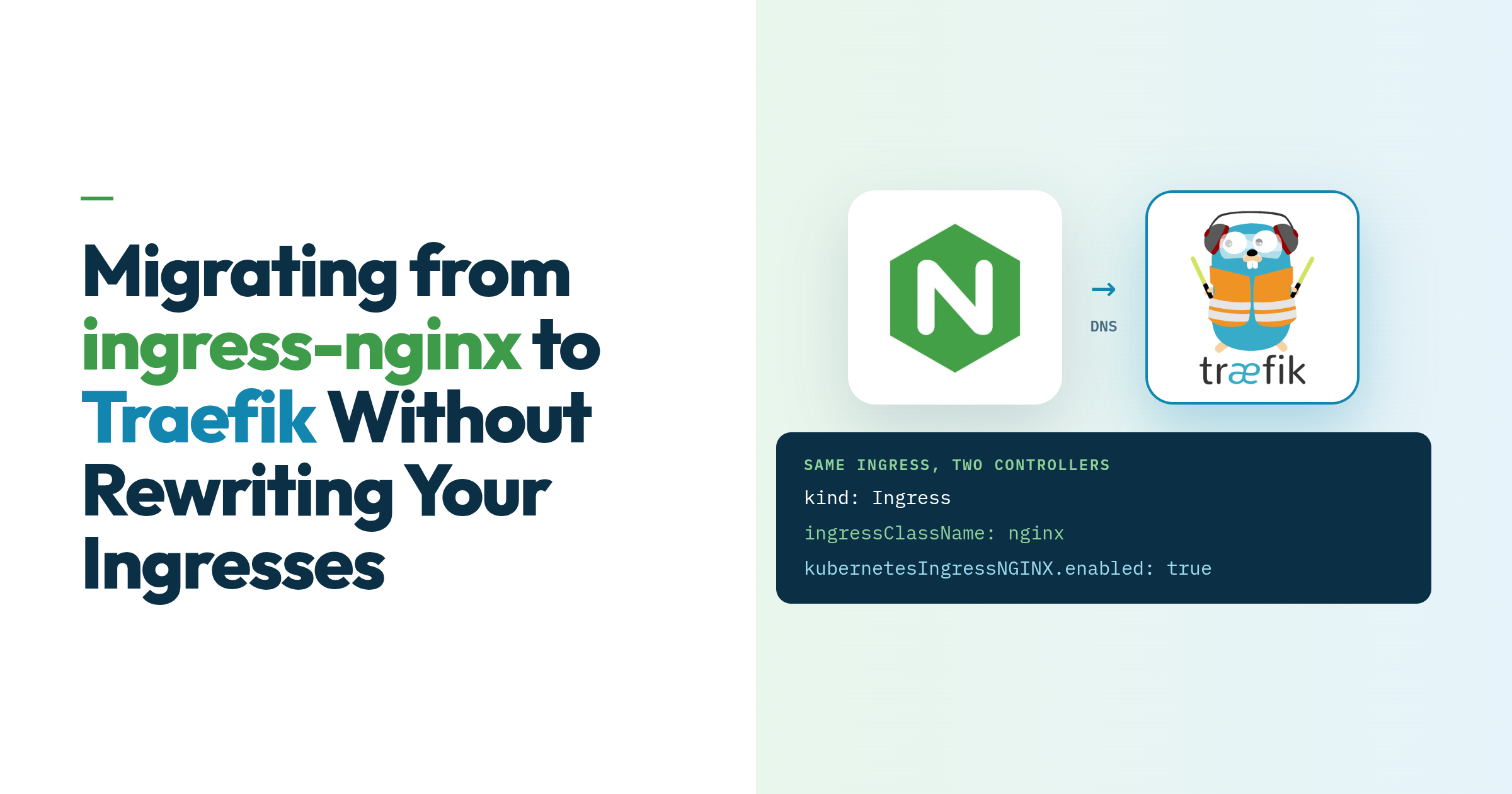
Ingress NGINX was retired in March 2026. The Kubernetes blog post from November 2025 said it in two sentences: “Best-effort maintenance will continue until March 2026. Afterward, there will be no further releases, no bugfixes, and no updates to resolve any security vulnerabilities that may be discovered.” Nothing stopped working; the post is explicit that existing deployments are not broken and the charts and images stay available. What stopped is anyone fixing it. Seven months later a lot of clusters still put every public hostname through a controller nobody patches, and the usual reason is the size of the job: a few hundred Ingresses, each with its own nginx.ingress.kubernetes.io/* annotations, and the only plan on the table is to rewrite all of them for the new controller in one go.
That plan is the wrong one. Three hundred Ingresses rewritten is three hundred routing changes in one pull request, none testable before the controller that serves them exists, with a rollback that reverts the lot while the site is down. ssl-redirect and proxy-body-size translate in a minute each; a configuration-snippet someone pasted in 2021 does not, and under a deadline it gets translated to a guess. Traefik added a feature for exactly this situation, a provider that reads the nginx Ingresses as they are, and it turns the migration from a rewrite into a parallel run: install Traefik next to nginx, point it at the same Ingress objects, prove it host by host on its own IP, move DNS, remove nginx, and only then convert annotations, at whatever pace suits you. The change that touches production is one DNS record, and the rollback is the same record pointed back.
To be clear about where I stand: I run Traefik on every cluster I operate and have for years, and I have set up ingress-nginx before, but I have not migrated a cluster from one to the other. The procedure below comes from Traefik’s documentation, the Helm chart’s own migration example and the write-ups of people who have done it, cited as I go. The operating advice is mine.
One Traefik, two Ingress providers
Traefik has always had a Kubernetes Ingress provider for plain Ingress objects and the traefik.ingress.kubernetes.io/* annotations. The Kubernetes Ingress NGINX provider is a second one in the same process. It looks for IngressClasses whose spec.controller is k8s.io/ingress-nginx (the controllerClass option; ingressClass defaults to nginx), takes every Ingress that names one of them, and builds Traefik routers from them, translating the nginx annotations into Traefik’s own middlewares as the configuration loads. The Ingress objects are read, not rewritten.
It arrived as an experimental feature in Traefik Proxy v3.5 on 24 July 2025, with the announcement putting it plainly: “This isn’t about building 100% compatibility with every NGINX annotation.” v3.6.2 deprecated the experimental flag, and the current docs do not mark it experimental at all. The Helm chart added it in 37.4.0 as providers.kubernetesIngressNginx and renamed the key to providers.kubernetesIngressNGINX in 40.0.0, so older snippets, Traefik’s own migration guide included, may carry the old spelling. The chart’s own example is the whole method in miniature: whoami behind one ingressClassName: nginx Ingress, curled first through nginx and then through a Traefik installed beside it with providers.kubernetesIngressNGINX.enabled=true, with the conclusion: “The same Ingress resource is now served by both NGINX and Traefik!”
Which annotations survive the translation decides whether this works for your cluster, and the annotation reference answers it row by row. The common ones are there: ssl-redirect and force-ssl-redirect, rewrite-target and use-regex, the permanent and temporal redirects, auth-url, auth-type with auth-secret, auth-tls-secret, whitelist-source-range and its newer spelling allowlist-source-range, proxy-body-size with the buffering and timeout family, affinity and session-cookie-*, backend-protocol, enable-cors, limit-rps, limit-rpm and limit-connections, canary-*, custom-http-errors, default-backend, ssl-passthrough, and the snippet annotations, each for a fixed list of directives.
Most rows carry a note, and the notes are where migrations go sideways. Rate limits return 429 where nginx returned 503. affinity-mode: balanced is not supported, only persistent. backend-protocol takes neither FCGI nor AUTO_HTTP. CORS is “partial support”. ssl-passthrough has “some differences in SNI/default backend handling”. load-balance is “not implemented; silently ignored”. The snippets accept add_header, proxy_set_header, more_set_headers, set, if, return, rewrite and a few others, nothing else, and only with the provider’s allowSnippetAnnotations on. Then the explicitly unsupported list: denylist-source-range, limit-rate, global-rate-limit, the mirroring annotations, the proxy-redirect-* and proxy-cookie-* rewrites, satisfy, stream-snippet, the tracing toggles and the per-Ingress ModSecurity annotations.
Regex paths deserve their own test. Two forum threads from January 2026, both on Traefik 3.6.6, report use-regex paths that routed under nginx and not under Traefik: one shows the router Traefik built from /api/v\d{1}/users, with the backslash doubled and a 404 where nginx had routed, the other a /test/[0-9]+ path that simply stopped matching. I have not reproduced either and 3.7 may have fixed them, but any host with use-regex: "true" goes first on the verification list.
The provider translates Ingress annotations. It does not translate the controller. Everything ingress-nginx did through its ConfigMap, body size, proxy timeouts, use-proxy-protocol, HSTS, ciphers, access log format, has to be set again on Traefik’s side, some of it as kubernetesIngressNGINX options with nginx-flavoured names (proxyBodySize, proxyReadTimeout, customHTTPErrors), the rest as entrypoint, TLS option and access log settings. Traefik’s migration guide has that mapping as its step zero. Two defaults differ in ways nothing in the cluster reports. ingress-nginx redirects HTTP to HTTPS with a 308 for any Ingress that has TLS; Traefik redirects nothing unless the entrypoint says so, and one production write-up from August 2026 found that out from monitoring after the cutover: “Every app in the cluster answered on port 80 in cleartext.” The same post met the second: a hostname with no certificate of its own gets Traefik’s generated self-signed certificate, and “Nothing in the control plane reports an error; the failure is a browser warning.” Both are one values key each, in the values file below.
The order that works
This assumes ingress-nginx installed by its Helm chart as release ingress-nginx in namespace ingress-nginx, exposed by a LoadBalancer Service, with cert-manager issuing certificates and ExternalDNS writing records. Adjust the names; the order does not change.
Take inventory
Before installing anything, find out which annotations you actually have:
kubectl get ingress -A -o json | jq -r '
  [.items[].metadata.annotations // {} | keys[] | select(startswith("nginx.ingress.kubernetes.io/"))]
  | group_by(.) | map("\(length)\t\(.[0])") | .[]' | sort -rn
One line per distinct annotation with a count. Check each against the reference page, and dump the ingress-nginx ConfigMap (kubectl -n ingress-nginx get configmap ingress-nginx-controller -o yaml) for the global settings that need a home on the Traefik side.
Install Traefik next to nginx
Traefik gets its own namespace, its own LoadBalancer Service and so its own public IP. This is the values file I run on cloud clusters, with the NGINX provider and the default certificate added:
ports:
  web:
    redirections:
      entryPoint:
        to: websecure
        scheme: https
        permanent: true
  websecure:
    http:
      tls:
        enabled: true
providers:
  kubernetesCRD:
    enabled: true
    allowCrossNamespace: true
  kubernetesIngress:
    publishedService:
      enabled: true
  kubernetesIngressNGINX:
    enabled: true
    publishService:
      enabled: false
additionalArguments:
  - "--providers.kubernetesingress.ingressclass=traefik"
  - "--metrics.prometheus=true"
metrics:
  prometheus:
    serviceMonitor:
      enabled: true
accessLog:
  enabled: true
tlsStore:
  default:
    defaultCertificate:
      secretName: wildcard-example-com
deployment:
  replicas: 2
podDisruptionBudget:
  enabled: true
  maxUnavailable: 1
helm repo add traefik https://traefik.github.io/charts
helm install traefik traefik/traefik -n traefik --create-namespace --version 41.6.0 -f values.yaml
Three of those lines are the migration. ports.web.redirections is the HTTP to HTTPS redirect nginx did for you. tlsStore.default.defaultCertificate is what any hostname without a Secret of its own gets served instead of the self-signed one; it points at a wildcard from cert-manager, which has to be DNS-01, since Let’s Encrypt will not issue wildcards over HTTP-01. And the ingressclass argument pins Traefik’s standard Ingress provider to the traefik class, so the two providers in this one process never both claim an Ingress; the provider docs warn that otherwise the NGINX provider “may lead to duplicated routers if you are also using the standard Kubernetes Ingress provider”. Two unpinned controllers fight over Ingress status on every reconcile, and a migration has two by design. From here, an Ingress with ingressClassName: nginx is served by nginx and by Traefik’s NGINX provider, an Ingress with ingressClassName: traefik by Traefik’s standard provider, and nothing twice by Traefik.
Decide who writes the status
Every Ingress has a status.loadBalancer.ingress field, and both controllers want their Service’s address in it: ingress-nginx through --publish-service, Traefik’s NGINX provider through publishService. If both write, the migration guide says, “Each controller overwrites the other in a tight reconciliation loop, with no error reported in the logs”, while “Routing itself is not affected.” The damage is in whatever reads the field. ExternalDNS does: its Ingress source walks status.loadBalancer.ingress, “adding each non-empty ip and hostname”, so a status holding both addresses is two A records for every hostname, and a status that flaps is records that flap.
So publishService.enabled: false on the NGINX provider, the chart’s default, spelled out in the values above anyway. nginx stays the only writer, ExternalDNS changes nothing, and Traefik is reachable only by its IP, which is what verification needs. The guide’s alternative, a transitional IngressClass for nginx so the controllers never share an Ingress, means editing every Ingress, the thing this approach avoids.
The standard provider has the same switch under a different spelling, publishedService, and there it stays on. Without it the status of every traefik-class Ingress is empty, kubectl get ingress shows no ADDRESS, and Argo CD marks every application behind them Progressing forever, since its Ingress health check is that one field having an entry (argoproj/argo-cd issue 1704).
Verify through Traefik’s own address
The hostnames still resolve to nginx. Tell curl where to connect instead:
TRAEFIK_IP=$(kubectl -n traefik get svc traefik -o jsonpath='{.status.loadBalancer.ingress[0].ip}')
curl -sS -o /dev/null -w '%{http_code} %{redirect_url}\n' \
  --resolve app.example.com:443:$TRAEFIK_IP https://app.example.com/
Do not add -k. The Secrets named in each Ingress’s spec.tls are read by both controllers, so Traefik should present the same Let’s Encrypt certificate nginx does, and a verification failure means a host that fell through to the default certificate, which is a finding. Loop over every host in the inventory, then exercise the annotations with notes: an auth-url login, a proxy-body-size upload, a whitelist-source-range from outside it, every use-regex path, a websocket. HTTP-01 challenges do not go through Traefik in this phase; Let’s Encrypt connects to whatever DNS says, which is still nginx, so cert-manager keeps renewing through nginx and Traefik serves the resulting Secrets.
Then open the dashboard. The chart does not expose it (ingressRoute.dashboard.enabled is false); set it to true, kubectl -n traefik port-forward deploy/traefik 8080:8080, open http://localhost:8080/dashboard/. The HTTP routers page lists every router Traefik built and the provider each came from. A host curl could not reach is either missing from that list, which points at the IngressClass, or present with a rule you did not expect, which points at the annotation reference. It is the first place I look when an Ingress does not route, before any log.
Move DNS
Lower the TTLs a day before. Then point the records at Traefik’s IP and watch the access logs on both sides until nginx goes quiet. The guide’s advice is to “keep NGINX running for at least 24-48 hours before uninstalling”, because some resolvers ignore TTLs, and a rollback in that window is the record pointed back.
How the records move depends on who writes them. Hand-managed: change them. Written by ExternalDNS from Ingress status: the guide suggests leaving Traefik’s publishService off and pointing nginx’s own publishing at Traefik’s Service with controller.publishService.pathOverride: traefik/traefik, so nginx writes Traefik’s address into every status and ExternalDNS follows; removing the override is the rollback. If your load balancer lets you move an IP between Services, that is the third way, and the one the August write-up used with a MetalLB address.
Keep the nginx IngressClass, then remove nginx
This is the step that bites, and the chart’s example says so in full: “When uninstalling the NGINX Ingress Controller helm chart, it removes the nginx IngressClass. Traefik needs this IngressClass to detect and serve Ingress resources that use ingressClassName: nginx. Before uninstalling NGINX, it’s recommended to ensure that an IngressClass like this will stay:”
apiVersion: networking.k8s.io/v1
kind: IngressClass
metadata:
  name: nginx
spec:
  controller: k8s.io/ingress-nginx
The provider finds the Ingresses through the IngressClass’s spec.controller, so with the object gone, every Ingress that says ingressClassName: nginx stops routing the moment helm uninstall returns. Under GitOps, put that manifest in the repository as a resource of its own. Under plain Helm, add helm.sh/resource-policy: keep to the IngressClass through helm upgrade --reuse-values; the guide is specific that kubectl annotate on the live object does not do it, because Helm consults its own release record, not the cluster.
Then, in this order:
kubectl delete validatingwebhookconfiguration ingress-nginx-admission
helm uninstall ingress-nginx -n ingress-nginx
kubectl get ingressclass nginx
The webhook goes first. ingress-nginx registers a validating admission webhook for Ingress objects with failurePolicy: Fail, so once its pods are gone the webhook rejects every Ingress create and update in the cluster. The August write-up puts it in one line: delete the namespace and orphan the webhook, and “every Ingress and certificate change in the cluster stops working.” If the last command prints the class, the Ingresses are still served, now by Traefik alone. Set publishService.enabled: true on the NGINX provider at this point: ADDRESS fills in with Traefik’s IP and ExternalDNS has one target per host.
Move cert-manager off the nginx name
Nothing breaks yet, because the solver Ingresses cert-manager creates still say ingressClassName: nginx and Traefik serves them. That holds only while the nginx IngressClass exists, and the next phase ends by deleting it. cert-manager’s HTTP-01 solver picks the controller with solvers[].http01.ingress.ingressClassName, the field the docs recommend over the older class. Change it on every Issuer and ClusterIssuer:
solvers:
  - http01:
      ingress:
        ingressClassName: traefik
Leaving it unset is worse than leaving it on nginx. The docs say that with no class, “all ingress controllers installed in your cluster will serve traffic for the challenge solver”, which during a migration is a solver Ingress with two owners. ExternalDNS needs a change only if it runs with --ingress-class=nginx.
Convert at your own pace
The cluster now runs Traefik only, every Ingress is unchanged, and the pressure is off. What remains is moving nginx-class Ingresses to Traefik’s own class and middlewares, and a variant of the inventory filter lists what is left:
kubectl get ingress -A -o json | jq -r '
  .items[]
  | select(any((.metadata.annotations // {}) | keys[]; startswith("nginx.ingress.kubernetes.io/")))
  | "\(.metadata.namespace)/\(.metadata.name)"'
Converting means setting ingressClassName: traefik, at which point the standard provider takes the Ingress and ignores the nginx annotations, and adding Traefik’s equivalents. Middlewares are CRD objects, usually in the application’s namespace, attached with the annotation traefik.ingress.kubernetes.io/router.middlewares whose value is <namespace>-<name>@kubernetescrd, comma-separated for several. Five translations cover most inventories.
ssl-redirect and force-ssl-redirect become nothing. The entrypoint redirection in the values file redirects every request on port 80, so the annotation is deleted. The reference notes the flip side, “Cannot opt-out per route if enabled globally”; a host that must answer plain HTTP needs an entrypoint without the redirect.
whitelist-source-range becomes an ipAllowList middleware, which Traefik v3 renamed from IPWhiteList with no other change:
apiVersion: traefik.io/v1alpha1
kind: Middleware
metadata:
  name: office
spec:
  ipAllowList:
    sourceRange:
      - 198.51.100.0/24
By default it checks the remote address of the connection, so behind a load balancer the source IP is right only with PROXY protocol on; otherwise add ipStrategy.depth to read X-Forwarded-For.
auth-type: basic with auth-secret becomes a basicAuth middleware pointing at the same Secret. The CRD provider accepts any generic Secret with exactly one key and reads it as htpasswd lines, so the auth key ingress-nginx asked for works as it is; a kubernetes.io/basic-auth Secret with username and password works too.
apiVersion: traefik.io/v1alpha1
kind: Middleware
metadata:
  name: admin-users
spec:
  basicAuth:
    secret: basic-auth
proxy-body-size becomes a buffering middleware with maxRequestBodyBytes, in bytes, so 50m is 52428800, and a request over it gets a 413. The default is the trap. Traefik’s own is 0, which the docs define as unlimited, while the NGINX provider carries proxyBodySize: 1048576 to match nginx’s 1m. So an Ingress on the nginx class is capped at 1 MiB whether it says so or not, and the same Ingress on the traefik class is uncapped until you add the middleware.
apiVersion: traefik.io/v1alpha1
kind: Middleware
metadata:
  name: body-50m
spec:
  buffering:
    maxRequestBodyBytes: 52428800
rewrite-target becomes replacePathRegex. The nginx idiom of path: /api(/|$)(.*) with rewrite-target: /$2 and use-regex is a plain /api prefix path plus:
apiVersion: traefik.io/v1alpha1
kind: Middleware
metadata:
  name: strip-api
spec:
  replacePathRegex:
    regex: "^/api/(.*)"
    replacement: "/${1}"
The docs prefer ${1} to $1 because $1x is read as a group named 1x. The original path reaches the backend in an X-Replaced-Path header.
Snippets are the residue. Whatever a configuration-snippet did that is not in the provider’s directive list has to be reproduced as a Traefik middleware (headers covers most add_header and proxy_set_header cases), as a plugin, or in the application. Two more things change when an Ingress leaves the nginx class. An ExternalName backend works under the NGINX provider, where disableSvcExternalName defaults to false, and stops under the standard one until providers.kubernetesIngress.allowExternalNameServices: true. Custom error pages come from customHTTPErrors and defaultBackendService on the NGINX provider, and from an errors middleware once converted.
When the filter prints nothing, set kubernetesIngressNGINX.enabled: false, delete the nginx IngressClass, and it is over. The August write-up left the provider on afterwards to keep rollback cheap, which costs nothing.
What I would tell a first-time Traefik operator
Four more things from running Traefik that the procedure had no reason to mention.
PROXY protocol on both sides or on neither. Set --entrypoints.websecure.proxyprotocol=true on Traefik because you want client IPs behind a cloud load balancer, and the load balancer has to send the header. On Hetzner Cloud that is the Service annotation load-balancer.hetzner.cloud/uses-proxyprotocol: "true", and its default is off. Traefik side only, and every connection is rejected while Traefik waits for a header that never comes, cert-manager’s HTTP-01 challenges included.
Learn the middleware reference format once. With a middleware called forward-auth in namespace traefik, the reference is traefik-forward-auth@kubernetescrd, and the doubled prefix trips everyone the first time. Traefik v3.7.11 added a safeNaming provider option that changes the separator to an underscore, traefik_forward-auth@kubernetescrd; it is off by default and warns at startup until set either way, and a reference in the wrong form is not resolved, so the router is silently not created.
Secrets behind TLS stores and TLS options hot-reload. Rotating the default certificate, or adding a CA to a client-certificate option, needs no restart.
On bare metal, the pods own the ports. With no cloud load balancer I run Traefik as a DaemonSet with hostPort 80 and 443, and the chart’s default rolling update, surge one and zero unavailable, cannot work there: the new pod cannot bind a port the old pod still holds. updateStrategy.rollingUpdate.maxSurge: 0, maxUnavailable: 1 deletes the old pod first.
Ending notes
The retired controller is not a crisis as long as the plan is not a rewrite. A second controller reading the same Ingress objects, an IP you can curl before anyone resolves it, one DNS change, one IngressClass you refuse to let Helm delete, and the annotation work moved off the critical path: that is the whole method, and it is the shape of the chart’s own example.
Once you are on Traefik, a few things become easy that were awkward before. A second Traefik instance from the same chart, on a ClusterIP Service with its own IngressClass, keeps admin UIs off the public IP; that is how I run a public and an internal instance per cluster. Servers that already hold a client certificate from a CA you control can authenticate with it instead of a token, through one TLSOption and the passTLSClientCert middleware; that is the mTLS post. And apps with no login of their own get Keycloak in front of them with the forwardAuth middleware, down to per-URL authorisation from Keycloak groups, in the forward-auth post. None of those need an Ingress rewritten either.
Thanks for your time :)