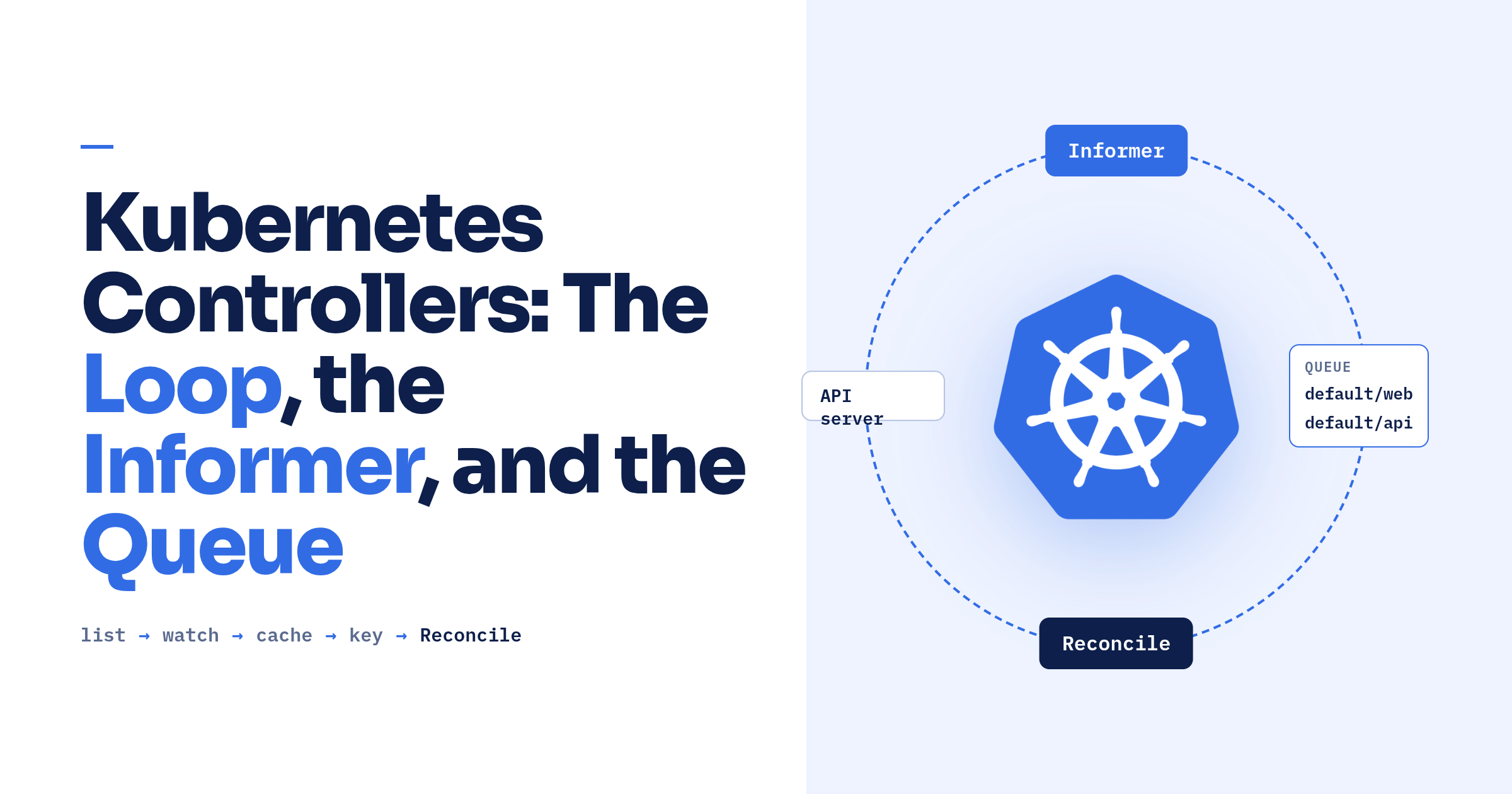
kubectl apply returns before anything runs
You run kubectl apply -f deployment.yaml. kubectl sends the Deployment to the API server. The API server validates the object and writes it to etcd. kubectl prints deployment.apps/web created. At this point no Pod exists, and no node has pulled an image. The only change is one record in etcd.
The Pods appear because a controller makes them appear. The Deployment controller runs inside kube-controller-manager and holds an open watch on Deployments. It sees the new object, compares the spec with the ReplicaSets that exist, and creates one. The ReplicaSet controller sees the new ReplicaSet and creates the Pods. The scheduler sees Pods with no node and assigns one. The kubelet on that node sees a Pod with its node name and starts the containers.
The API server does not call any of these components. Each one connects to the API server, reads the objects that it watches, and acts on what it finds. This is a pull model. A controller is a client of the API server, with the same list and watch verbs that kubectl uses.
The Kubernetes docs describe the Job controller in the same way. It does not run Pods itself. It tells the API server to create or remove them.
Everything in Kubernetes that looks automatic is one of these loops. When you see how the informer feeds the loop, you can read the source of any controller, and you can write your own.
Level-triggered, not edge-triggered
A controller does not react to “what changed”. It reacts to “this object may need work”. The reconcile reads the whole object and the whole state of the world, and then it corrects the difference. The controller-runtime godoc for Reconciler says this directly: reconciliation is level-based, and individual events do not drive the action. The Request that a reconcile receives contains a namespace and a name, and nothing about the event.
There are good reasons for this design. When the controller restarts, the informer lists every object again, and each object arrives as an add with no history. When a watch stays down for longer than the API server keeps history, the client gets 410 Gone and must list again. The queue merges ten edits into one key, so the reconcile sees the last state and not the ten steps. By default, controller-runtime also sends every cached object to the handlers again every ten hours, as an update with no change in it.
Because of this, the reconcile cannot trust a diff. It must be idempotent. If you run it twice on the same state, the second run changes nothing. This is what makes the retry safe. A reconcile that fails halfway can run again from the start, because the start is always “read everything, then fix the difference”.
The reconcile loop, in code
The loop below is in controller-runtime style, with an example Widget kind that owns one external resource. The comments mark the steps. The text after the code explains each return value.
func (r *WidgetReconciler) Reconcile(ctx context.Context, req ctrl.Request) (ctrl.Result, error) {
	const finalizer = "widget.example.com/finalizer"

	// 1. Read the object. r.Get reads the informer cache, not the API server.
	var w examplev1.Widget
	if err := r.Get(ctx, req.NamespacedName, &w); err != nil {
		// NotFound: the object is gone and there is nothing to do.
		// A nil error tells the queue to forget the key.
		return ctrl.Result{}, client.IgnoreNotFound(err)
	}

	// 2. The object is being deleted. Clean up, then let it go.
	if !w.DeletionTimestamp.IsZero() {
		if controllerutil.ContainsFinalizer(&w, finalizer) {
			if err := r.deleteExternal(ctx, &w); err != nil {
				return ctrl.Result{}, err // retried with backoff, finalizer stays
			}
			controllerutil.RemoveFinalizer(&w, finalizer)
			if err := r.Update(ctx, &w); err != nil {
				return ctrl.Result{}, err
			}
		}
		return ctrl.Result{}, nil
	}

	// 3. Add the finalizer before anything external exists.
	if !controllerutil.ContainsFinalizer(&w, finalizer) {
		controllerutil.AddFinalizer(&w, finalizer)
		if err := r.Update(ctx, &w); err != nil {
			return ctrl.Result{}, err
		}
	}

	// 4. Compare the spec with the world and make one change.
	actual, err := r.observe(ctx, &w)
	if err != nil {
		return ctrl.Result{}, err
	}
	if actual == nil {
		id, err := r.createExternal(ctx, &w)
		if err != nil {
			return ctrl.Result{}, err
		}
		w.Status.ID = id
		// Come back in one second to observe the new resource. Do not depend on
		// the status update event for that, because a predicate may drop it.
		return ctrl.Result{RequeueAfter: time.Second}, r.Status().Update(ctx, &w)
	}

	// 5. Record what you saw. Status is the controller's own record.
	w.Status.State = actual.State
	if err := r.Status().Update(ctx, &w); err != nil {
		return ctrl.Result{}, err
	}

	// 6. Nothing to do now. Check again later.
	return ctrl.Result{RequeueAfter: time.Minute}, nil
}
Each return value tells the queue something different. The rules below come from pkg/internal/controller/controller.go in controller-runtime v0.23.0.
ctrl.Result{}, nil means the work is done. The controller calls Forget on the key, which resets the backoff counter, and the key leaves the queue. The reconcile does not run again until a new event adds the key.
ctrl.Result{RequeueAfter: d}, nil means the work is done for now. The controller calls Forget and then adds the key again after the duration d. KubeProvisioner ends its create path with RequeueAfter: 1 * time.Second, so the next reconcile checks the new instance in AWS one second later.
ctrl.Result{}, err means the work is not done. The controller logs the error, counts it in the metrics, and adds the key back with rate limiting. The per-key backoff grows with each failure and resets on the next success. The controller ignores the Result when the error is not nil. If the error is a reconcile.TerminalError, the controller logs it and does not add the key back.
ctrl.Result{Requeue: true}, nil also adds the key back with rate limiting. v0.23.0 marks the Requeue field as deprecated, and the godoc says to use RequeueAfter instead.
Where the object comes from: the informer
The reconcile calls r.Get. That call does not go to the API server. It reads a local cache that an informer keeps current. The informer is the part of client-go that turns the API server’s list and watch into that cache, plus a stream of events.
The informer starts with a list. The reflector requests every object of one kind and keeps the resourceVersion from the list response. Then it opens a watch from that resourceVersion. The API server streams every change after that point, so the reflector misses nothing between the list and the watch. If the connection drops, the reflector opens a new watch from its last resourceVersion. The reflector also asks for BOOKMARK events, which carry only a resourceVersion, so a quiet watch can still move its position forward.
The reflector does not write to the cache directly. It pushes each change from the watch into a FIFO as one delta. In client-go v0.35.0 that FIFO is a RealFIFO by default, behind the InOrderInformers feature gate, and it delivers every delta in order. With the gate off, the informer uses the older DeltaFIFO, which merges the pending deltas for one object into one list. The informer pops from the FIFO, applies the delta to the cache, and only then calls the event handlers.
The order matters. The client-go godoc says that notifications happen after the corresponding cache update. A handler that reads the cache sees at least the state in the event.
The API server keeps watch history for a limited time, five minutes by default with etcd 3. A watch that asks for an older resourceVersion gets 410 Gone. The reflector then lists again. The FIFO emits a Replaced delta for every object in the new list. It emits a Deleted delta for every cached object that the new list does not contain. The informer rebuilds the cache from the new list.
The cache is a client-go Indexer. It stores each object under its key, namespace/name, and keeps extra indices, by namespace by default. In controller-runtime, the manager’s default client reads from this cache and sends writes directly to the API server. The manager starts an informer the first time a controller asks for a kind. That is why r.Get is cheap, and why a controller can read objects as often as necessary with no API call.
flowchart LR
    A[API server] -- list, then watch --> R[Reflector]
    R -- Added / Updated / Deleted / Replaced --> D[FIFO: RealFIFO or DeltaFIFO]
    D -- pop --> I[Indexer: the cache]
    I -- after the cache update --> H[Event handlers]
    H -- key only --> Q[Workqueue]
    Q --> W[Worker]
    W -- Reconcile --> I
    W -- writes --> A
From event to queue
The event handler is short on purpose. It does not pass the object to the controller. It computes the key, namespace/name, and adds that string to the queue. The object stays in the cache.
This is what a raw client-go handler and worker look like. The in-tree Deployment controller and the sample-controller use a similar shape.
informer.AddEventHandler(cache.ResourceEventHandlerFuncs{
	AddFunc: func(obj interface{}) {
		if key, err := cache.MetaNamespaceKeyFunc(obj); err == nil {
			queue.Add(key)
		}
	},
	UpdateFunc: func(_, newObj interface{}) {
		if key, err := cache.MetaNamespaceKeyFunc(newObj); err == nil {
			queue.Add(key)
		}
	},
	DeleteFunc: func(obj interface{}) {
		// obj can be a DeletedFinalStateUnknown tombstone. This key func handles both.
		if key, err := cache.DeletionHandlingMetaNamespaceKeyFunc(obj); err == nil {
			queue.Add(key)
		}
	},
})

// One worker. Run as many of these as you want in parallel.
for {
	key, shutdown := queue.Get()
	if shutdown {
		return
	}
	if err := sync(key); err != nil { // sync reads the object from the indexer by key
		queue.AddRateLimited(key)
	} else {
		queue.Forget(key)
	}
	queue.Done(key)
}
The queue is k8s.io/client-go/util/workqueue. Its godoc lists four properties. Three of them matter here.
- It is fair. Keys come out in the order in which they enter.
- It is stingy. If the handler adds a key several times before a worker takes it, the worker processes it once. Two workers never process one key at the same time.
- It accepts a key that a worker already holds. The queue marks that key dirty and adds it back when the worker calls
Done.
The second property removes the duplicates. Ten quick edits to one object produce ten events and one reconcile.
The rate limiting is a separate layer. A worker calls AddRateLimited after a failure instead of Add. The default limiter in client-go v0.35.0 takes the larger of two delays. One is a per-key exponential backoff that starts at 5 ms, doubles on each failure, and stops at 1000 s. The other is an overall token bucket at 10 per second with a burst of 100. Forget resets the backoff counter.
In controller-runtime v0.23.0, the default queue is not the client-go queue. The default is a priority queue that controller-runtime provides. That queue keeps the per-key exponential backoff, 5 ms to 1000 s, and drops the token bucket. Set UsePriorityQueue: false in controller.Options to get the client-go queue back. Both queues remove duplicates, and both give one key to one worker at a time.
The reconcile reads the cache again instead of the event payload. There are three reasons.
- The payload can be older than the cache, because the informer may apply more deltas before the handler runs.
- The queue merges several events, so the payload is one of several states.
- The handler may add the key again while the reconcile runs.
The key only identifies the object. The cache holds the current state.
Workers and concurrency
MaxConcurrentReconciles sets the number of workers for one controller. It defaults to 1. On Start, the controller launches that many goroutines, and each one loops on processNextWorkItem. A comment in Start, above that loop, states one rule: the worker never calls the reconcile handler concurrently for the same object.
That guarantee comes from the queue, not from the controller. The queue keeps a set of keys in process. The queue does not give a key in that set to a second worker. If the same key arrives while a worker holds it, the queue waits, then hands the key out again after Done. So two reconciles for default/web never overlap. Reconciles for default/web and default/api run in parallel when you have two workers.
Leader election solves a different problem: two replicas of the same binary. Without it, both replicas run the controller, and both write to the API server. The controller-runtime manager takes LeaderElection: true and a LeaderElectionID, and uses a Lease object as the lock by default. Only the replica that holds the lease starts the controllers. If the leader loses the lease, Start returns, and the godoc says the binary must exit at once. KubeProvisioner creates its manager with LeaderElectionID: "c56fc483.cloud.com", and its --leader-elect flag defaults to false.
The client-go leaderelection godoc adds one caution. The implementation does not guarantee that only one client acts as leader. It relies on local timestamps and on the lease duration. Make sure your reconcile is idempotent even with leader election on.
Status, finalizers, and owner references
Status is the controller’s own record of the world. The spec is what the user wants. The status is the controller’s last observation. KubeProvisioner’s Ec2Instance status holds InstanceID, State, PublicIP, PrivateIP, PublicDNS, PrivateDNS, and LaunchTime. The README shows three of them, State, PublicIP, and InstanceID, as columns in kubectl get ec2instances -w.
When you enable the status subresource on a CRD, the object gets a separate /status endpoint. With the subresource on, a PUT, POST, or PATCH to the main endpoint ignores changes to the status stanza. A PUT to /status ignores changes to everything except the status stanza. metadata.generation increments for all changes except changes to .metadata or .status, so a status write does not change the generation.
RBAC treats a subresource as its own resource name. The kubebuilder markers in KubeProvisioner grant ec2instances/status with get;update;patch in a separate rule from ec2instances. That split lets you give a user write access to the spec and no write access to the status.
A finalizer is a string in metadata.finalizers that says “do not let this object disappear until I have cleaned up”. When you delete an object with a finalizer, the API server sets metadata.deletionTimestamp, returns 202 Accepted, and keeps the object. The delete is now an update. The controller sees the update, does its cleanup, removes its finalizer, and writes the object. When the list is empty, the API server removes the object. Once the timestamp exists, nobody can add a new finalizer, and nobody can bring the object back.
KubeProvisioner uses the finalizer ec2instance.compute.cloud.com, and the controller appends it on the first reconcile. When the object has a DeletionTimestamp, the controller calls deleteEc2Instance, then controllerutil.RemoveFinalizer, then r.Update. If the AWS call fails, the controller returns the error and the finalizer stays. The object then stays too, and the next reconcile tries again. The Kubernetes docs ask for a qualified name with a slash, such as example.com/finalizer-name. Use that form in a new controller.
Owner references are the other cleanup path, for objects inside the cluster. A ReplicaSet carries an ownerReferences entry that points at its Deployment, and each Pod points at its ReplicaSet. When you delete the owner, the garbage collector deletes the dependents, in the background by default. The reference with controller: true marks the one controller that manages the object. controllerutil.SetControllerReference writes that entry for you. Owner references do not cross namespaces, and the docs say that the garbage collector treats an invalid cross-namespace reference as absent.
Watching more than your own kind
A controller for one kind usually has to run a reconcile when a related kind changes. The Deployment controller has to react when one of its ReplicaSets changes, or a rollout would stall. In kube-controller-manager, NewDeploymentController registers handlers on three informers: Deployments, ReplicaSets, and Pods. The ReplicaSet handlers read the controller reference on the ReplicaSet, resolve the Deployment, and add the Deployment’s key to the queue. The reconcile for the Deployment then reads its ReplicaSets from the cache.
The controller-runtime builder gives you the same thing.
func (r *WidgetReconciler) SetupWithManager(mgr ctrl.Manager) error {
	return ctrl.NewControllerManagedBy(mgr).
		For(&examplev1.Widget{}).
		Owns(&appsv1.Deployment{}).
		Watches(&corev1.ConfigMap{}, handler.EnqueueRequestsFromMapFunc(r.widgetsForConfigMap)).
		WithOptions(controller.Options{MaxConcurrentReconciles: 4}).
		Complete(r)
}
For is the root kind. The godoc says it is the same as a Watches on that kind with handler.EnqueueRequestForObject, which adds the key of the object in the event. Owns watches a kind that your controller creates. Its default handler is EnqueueRequestForOwner with OnlyControllerOwner, so a change to a Deployment adds the key of the Widget named in the controller reference.
Watches takes any handler. EnqueueRequestsFromMapFunc runs your function on the object and adds every key it returns. That is how a ConfigMap change causes a reconcile for each Widget that reads it.
All controllers in one manager share one cache. The manager holds one informer per kind, and each controller adds its handlers to that informer. If three controllers watch Pods, there is one watch on Pods and one copy of each Pod in memory. An Owns on a common kind adds a handler, not a second watch. The client-go godoc notes that the informer delivers events to one handler in order, but it does not coordinate between different handlers.
What controller-runtime hides from you
Each piece of the raw client-go controller maps to one piece of what kubebuilder scaffolds. This table lets you read in either direction.
| Raw client-go | controller-runtime / kubebuilder |
|---|---|
Reflector, FIFO, Indexer, together as a SharedIndexInformer |
The manager’s cache.Cache, one informer per kind, started on first use |
A lister or indexer.GetByKey |
r.Get and r.List through the manager’s client |
cache.ResourceEventHandlerFuncs plus MetaNamespaceKeyFunc |
For, Owns, Watches with a handler.EventHandler |
workqueue.NewTypedRateLimitingQueue |
The controller’s queue: priorityqueue by default in v0.23.0, or the client-go queue with UsePriorityQueue: false |
for i := 0; i < workers; i++ { go worker() } |
MaxConcurrentReconciles |
syncHandler(key) and handleErr |
Reconcile(ctx, req) and the Result and error rules above |
cache.WaitForCacheSync before the workers start |
The manager waits for the caches before it starts a controller |
tools/leaderelection set up by hand |
ctrl.Options{LeaderElection: true, LeaderElectionID: ...} |
The kubebuilder scaffold puts the types in api/v1 and a reconciler in internal/controller. The cmd/main.go file creates the manager and calls SetupWithManager for each reconciler. The RBAC rules come from the +kubebuilder:rbac markers above Reconcile.
If you want to see what this looks like in real code, the EC2 reconciler in KubeProvisioner is about 100 lines. It is a learning-grade operator, not a product. It has three CRDs in the group compute.cloud.com/v1: Ec2Instance, S3Bucket, and SqsQueue. It uses controller-runtime v0.23.0 and client-go v0.35.0, and the README installs it with the Helm chart in ./dist/chart. The reconcile, the finalizer, the status writes, and the Result values are all in internal/controller/ec2instance_controller.go.
Things that bite
The cache is stale right after a write. You call r.Update, return, and the next reconcile starts before the informer has received the new version. r.Get returns the old object.
The controller-runtime FAQ gives two defences. Use deterministic names for objects you create, so the API server rejects the duplicate. When that is not possible, keep a record of each write. Check that record on the next reconcile. Write the controller as if the cache is correct but a little behind, because that is what it is.
Your own status update is an event. Every r.Status().Update that changes something sends an update through the informer, and the handler adds your key to the queue again. One extra reconcile per write is fine when the reconcile is idempotent. A reconcile that writes a changing value on every reconcile, for example a timestamp, never stops.
Write the status only when a field changes. Or filter updates with predicate.GenerationChangedPredicate. That predicate drops updates where metadata.generation has the same value.
Requeue: true together with a returned error. The error takes priority: the controller ignores the Result and adds the key with rate limiting. It also logs a warning: RequeueAfter and Requeue will always be ignored if the error is non-nil. KubeProvisioner’s delete path returns ctrl.Result{Requeue: true}, err, and the behaviour is the same as ctrl.Result{}, err. Version 0.23.0 of controller-runtime deprecates the field. Return an empty Result with the error.
Create calls are not idempotent. A reconcile can run twice for one object. The process can stop after it creates an external resource and before it records the ID. KubeProvisioner checks Status.InstanceID before it creates an instance. A second reconcile with a recorded ID does not create a second instance. That reconcile calls checkEC2InstanceExists to confirm that the instance still exists in AWS.
The window between the AWS call and the status write is still open. Close it with an idempotency token on the create call. As an alternative, add a tag when you create the instance. Then search for the tag before you create a new one.
Two controllers write the same field. Each one sets the field to its own value, each write is an event for the other, and the two alternate forever. The symptom is a steady stream of updates on an object that nobody edits. The rule is one owner per field. kubectl get -o yaml --show-managed-fields shows the manager for each field. That is the fastest way to find the second writer.
Ending notes
One design choice explains most of this post: the handler adds the key to the queue, never the object. Because the key carries no state, the reconcile must read the cache and accept any state it finds there. So the reconcile must be idempotent. An idempotent reconcile lets the queue merge events, retry with backoff, and resend everything after a restart. Every rule in this post about when the key goes back on the queue follows from that one choice.
If you read the sources, read them in this order:
- The Kubernetes docs page on controllers, for the model.
- The sample-controller, for the raw client-go pieces.
- The controller-runtime godoc for
reconcileandcontroller, for theResultrules. - One real reconciler, start to finish.
I hope this post was helpful, thanks for reading :)