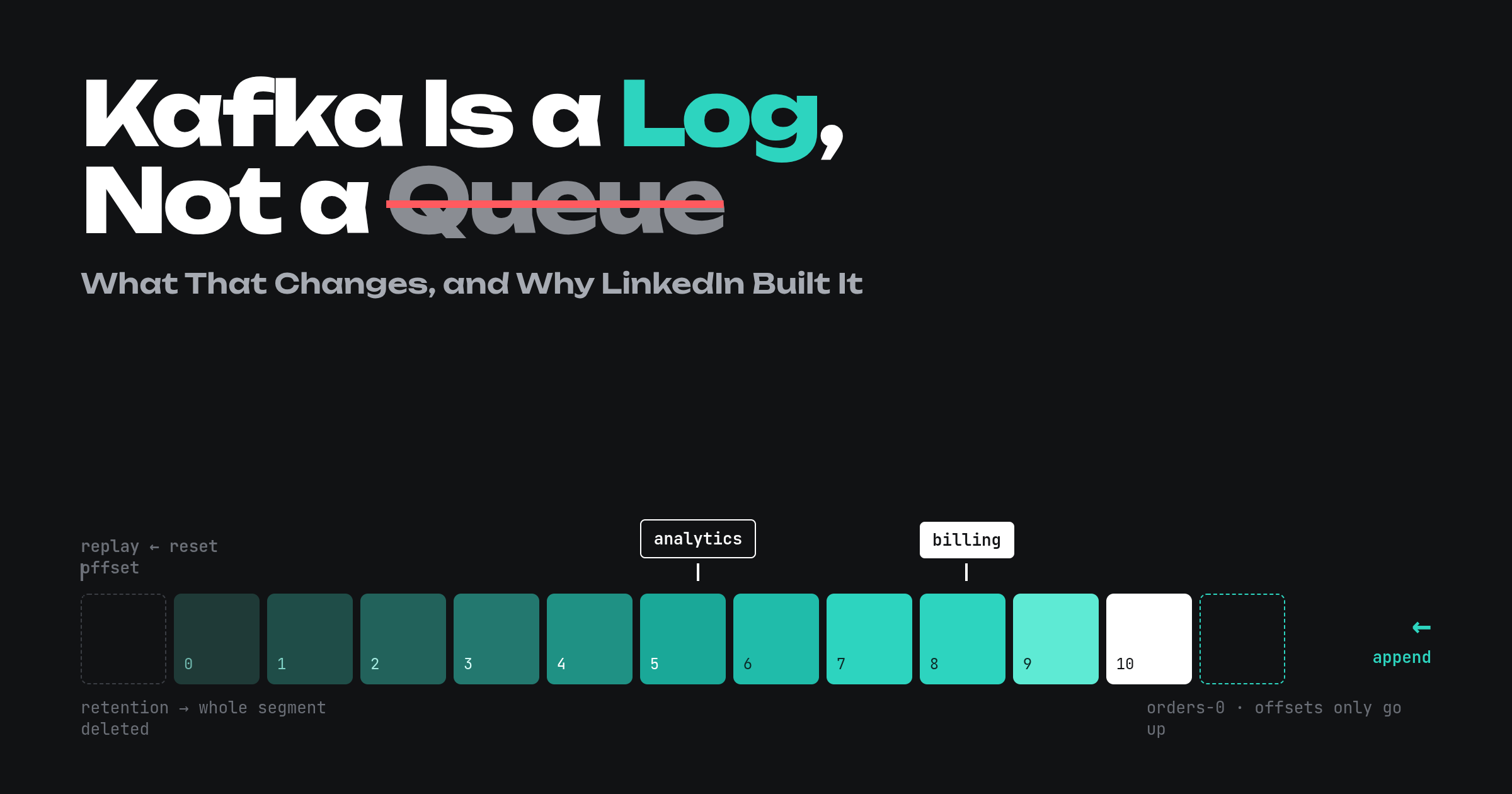
Kafka is usually introduced as a message queue that goes faster. That is the description I carried around for a long time, and it explains almost nothing. It does not explain why a consumer can read last Tuesday’s records again, why two unrelated teams can read the same topic without stepping on each other, why ordering is only promised inside a partition, or why there is no per-record delete anywhere in the API.
All of those follow from one decision. Kafka is not a queue. It is a log: an append-only file, split across machines and copied for safety, that consumers read at their own pace while remembering their own position. Hold that one idea and most of the design falls out of it. This post is the model from the file up, and the LinkedIn problem that made it the right answer.
What is it, actually?
Start with a single partition, because that is the unit everything else is built on. On disk a partition is a directory of segment files. Each segment is a plain file of records appended in order, plus an index that maps offsets to byte positions. When a segment reaches a size limit (log.segment.bytes, 1 GiB by default) the broker rolls a new one and leaves the old one alone.
$ ls /var/lib/kafka/data/orders-0/
00000000000000000000.index
00000000000000000000.log
00000000000000000000.timeindex
00000000000001048576.index
00000000000001048576.log
00000000000001048576.timeindex
The file name is the offset of the first record in that segment. An offset is just a number: the position of a record in its partition, starting at zero and going up by one with each append. It is the only identity a record has. The 2011 paper is explicit that this was a choice. There are no message IDs, so there is no seek-heavy index mapping IDs to disk locations, and the offset of the next message is the current offset plus the current message’s length.
A topic is a named set of partitions. num.partitions defaults to 1, so a topic created without saying otherwise is a single log on a single broker. Give it twelve partitions and the records are spread across twelve independent logs, which can live on twelve brokers.
kafka-topics.sh --bootstrap-server broker:9092 --create \
  --topic orders --partitions 12 --replication-factor 3
Which partition a record lands in is decided by the producer, not the broker. If the record has a key, the producer hashes the key and takes it modulo the partition count, so every record with key customer-42 goes to the same partition for as long as the partition count does not change. If there is no key the producer spreads records across partitions. That hash is the whole mechanism behind ordering, and I come back to it.
Replication is per partition too. Each partition has one leader and some followers, placed on different brokers; --replication-factor 3 means one leader and two followers. The leader takes every write and, by default, serves every read. Followers fetch from the leader the way a consumer would and append to their own copy. The leader tracks which followers are caught up, and that set is the ISR, the in-sync replicas. A record is committed once every replica in the ISR has it, and the docs put the guarantee plainly: with f+1 replicas, a partition survives f failures without losing a committed record. The producer’s acks setting decides whether it waits for that commit. acks=all with min.insync.replicas=2 on a three-replica topic is the usual durable configuration, and it means a write is refused rather than quietly under-replicated when two of the three replicas are down.
A consumer group is how reads are shared out. Every consumer joins with a group.id. Within a group each partition is assigned to exactly one consumer, so a twelve-partition topic can be read by up to twelve consumers in parallel, and a thirteenth sits idle. Two groups with different IDs do not know about each other at all. Each gets every record.
What happens on a write, and on a read?
A producer batches records per partition, compresses the batch if told to, and sends it to the leader of that partition. The leader appends the batch to the end of the active segment. It writes to the filesystem, which means the page cache; it does not fsync per record, and the docs are open about that: durability comes from replication, not from flushing. Followers fetch the new bytes, append them, and report their position. Once the ISR has caught up the leader advances the high watermark and the records become visible to consumers. If the producer asked for acks=all, that is when it hears back.
A read is a fetch request: partition, offset, maximum bytes. The broker finds the segment, looks up the byte position in the index, and ships bytes from there. If nothing new has arrived, the request can wait (fetch.max.wait.ms) rather than return empty, which is how a pull model avoids a tight polling loop. The consumer gets a batch, hands records to the application, and remembers the next offset to ask for.
Notice who holds state. The broker keeps the records and knows the end of each log. It does not know who has read what. The consumer’s position is one integer per partition, and committing an offset means writing that integer somewhere it will survive a restart; modern Kafka stores it in an internal topic called __consumer_offsets, which is itself a log. A consumer that crashes picks up from its last committed offset. One that wants to reprocess sets its offset back and reads again.
$ kafka-consumer-groups.sh --bootstrap-server broker:9092 --describe --group billing
GROUP    TOPIC   PARTITION  CURRENT-OFFSET  LOG-END-OFFSET  LAG
billing  orders  0          184203          184211          8
billing  orders  1          183990          183990          0
That output (trimmed of the consumer ID and host columns) is the whole consumer-side model in two numbers. LOG-END-OFFSET is the broker’s fact. CURRENT-OFFSET is the group’s claim. Lag is the difference.
Why is ordering per partition, not per topic?
Because a partition is one file appended by one leader, and a topic is several of them with nothing coordinating between them. Records in partition 0 are in the order they were appended to partition 0. Records in partition 0 and partition 7 have no defined order relative to each other, and Kafka does not pretend otherwise. The paper says it in one sentence: messages from a single partition are delivered in order, with no guarantee across partitions.
This is why the key matters. If every event about customer-42 carries that key, every event about that customer is in one partition, in order, read by one consumer in the group. That is all the ordering most systems need. If you need a global order you need one partition, which means one leader and one consumer, and no parallelism on either side.
Two consequences bite people. Adding partitions to a topic changes the modulo, so keys start hashing to different partitions, and the “all events for one key in one place” property no longer holds across the change. And a hot key is a hot partition: if one customer produces a tenth of all events, one partition carries a tenth of the topic and the consumer assigned to it does a tenth of the work alone.
What happens to old data?
Nothing, until retention says so. By default a broker keeps a partition’s segments for 168 hours (log.retention.hours) and has no size cap (log.retention.bytes=-1). Retention is enforced per segment: when a segment ages past the limit, the whole file is deleted. Whether anyone has read it is not part of the decision. Time-based deletion can also be switched off for a topic with retention.ms=-1, in which case the data stays for as long as the disk holds it. That is the setting under event sourcing on Kafka: the topic is the full record of what happened, nothing is ever cleaned out of it, and the current state is whatever you get by reading it through from the start.
The alternative to deleting by age is compacting by key. With cleanup.policy=compact on a topic, a background cleaner rewrites old segments and keeps only the latest record for each key, so the topic becomes a changelog that always holds at least the last known value for every key. The two policies can be combined on one topic, in which case segments older than the retention limit are still deleted even though the topic is compacted. A record with a key and a null value is a tombstone: it says “delete this key” and is itself removed after delete.retention.ms. Compacted topics are how a consumer can rebuild a full table from Kafka without reading every update since the beginning of time, and they are what Kafka Streams uses to recover its own state after a crash. Next to an event-sourced topic, a compacted one is the snapshot: current state per key, so a new reader can load that first instead of replaying the whole history.
How is it different from a message queue?
I will use RabbitMQ as the queue, since it is the one most people have run, with SQS as the hosted cousin. Most of what follows applies to ActiveMQ and the rest of the JMS family too.
A queue is a broker that owns the message. A producer publishes; the broker routes it to a queue; when a consumer is ready the broker pushes it (basic.consume); the consumer acknowledges; the acknowledgement tells the broker the message can be discarded. If the consumer rejects it or dies, the broker requeues it or dead-letters it. Delivery state lives on the broker and the message’s life ends at the ack. SQS is the same shape with different words: a received message is hidden for a visibility timeout and deleted when the consumer says so. Every detail of that design is about one message going to one consumer once.
Kafka inverts each of those. The broker does not push; the consumer pulls from an offset. The broker does not track delivery; the consumer commits its own position. Nothing is discarded on read; records stay until retention removes them. And the same record is read by every group that subscribes, not by whichever consumer got it first.
The differences people notice in practice follow from those.
Replay. With a queue, a message you have acknowledged is gone. If the code that handled it had a bug, you fix the bug and the data is not there to run through it again. With Kafka you reset the group’s offset to a timestamp or a number and read forward. The paper called this out in 2011 as a violation of the common contract of a queue and an essential feature anyway, and the examples it gave are the same ones people give today: reloading a warehouse after a fix, and recovering a consumer that only checkpoints occasionally.
Fan-out. Getting a RabbitMQ message to several consumers means several queues bound to one exchange, each with its own copy, and a fourth consumer means a fourth binding. In Kafka a new consumer is a new group.id. The producer, the topic, and the existing readers are not touched. The data is written once and read N times, mostly out of the page cache.
Ordering. A single RabbitMQ queue is ordered until there are competing consumers and redeliveries, at which point it is not. Kafka’s ordering is weaker on paper and stronger in practice: only per partition, but per partition for as long as the data exists, with the key as the lever.
Throughput. Kafka is fast for boring reasons. It writes sequentially and reads sequentially, and the docs make the case with a number: linear writes on a six-disk RAID-5 array of commodity SATA disks run at hundreds of megabytes a second while random writes run at about a hundred kilobytes, a gap the docs put at over six thousand times. It keeps no in-process cache and relies on the kernel page cache, so a consumer that is keeping up reads from memory and a broker restart does not lose the cache. Producers and consumers move batches, not records, so one round trip carries thousands of records. And on the read path the broker uses sendfile to move bytes from the page cache to the socket without passing them through the JVM; the docs count four copies and two system calls on the ordinary path and a single copy to the NIC buffer on this one. (That optimisation is lost when clients talk TLS, because the broker has to encrypt the bytes first.) The 2011 paper’s producer test is a fair summary of the result. With one broker and one producer, Kafka reached about 50,000 messages a second unbatched and about 400,000 with batches of 50, which the authors describe as orders of magnitude above ActiveMQ and at least twice RabbitMQ, and they note that the Kafka producer in that test did not wait for acknowledgements. They also say outright that the point was not that the other systems were inferior, since both had more features, but that a specialised system could be much faster.
Where a queue is the better tool. A queue routes per message: topic exchanges, header matching, a message that lands in three queues because of its routing key. Kafka routes per topic, and the producer picks the partition. A queue has priorities; Kafka has an append-only file, and the only order is arrival order. A queue tells you a specific message was handled and lets you drop a specific message; Kafka has a position in a log and no per-record delete. A queue does request/reply with a reply-to header and a correlation ID; in Kafka you build that yourself, and it is awkward. A queue gives per-message retry with a delay and a dead-letter destination; Kafka gives you an offset you can refuse to advance, which blocks the partition behind it, so dead-lettering is something you write. And a queue is small. RabbitMQ on one node with a few queues is an afternoon; a Kafka cluster is three brokers at minimum for replication worth having, and for most of its life it needed a ZooKeeper ensemble beside it. If the job is “give each task to one worker and tell me when it is done”, a queue is the right shape and Kafka is the wrong one.
What do people use it for?
The short answer is anything where more than one system wants the same stream of facts. A few shapes come up constantly.
The most common one is events between services. Service A writes order.placed to a topic; billing, fulfilment, fraud and analytics each read it in their own group at their own pace. A does not know how many readers there are, and adding one does not involve A’s team. This is the use Cloudflare describes in its 2022 post on its own clusters, running since 2014.
The original use was logs and metrics. Every host writes to a topic; collectors, dashboards, alerting and long-term storage read it. The paper’s two categories were user activity events and operational metrics, and that is still a fair description of what flows through most clusters.
Change data capture is the same idea pointed at a database. Debezium runs as a Kafka Connect connector, reads the database’s own transaction log, and writes each row change into a topic. A search index, a cache or another database then rebuilds itself from a compacted topic instead of polling the source.
The last shape is stream processing. Kafka Streams is a library, shipped with Kafka since 0.10 in 2016, that reads topics, joins, aggregates and windows them, and writes topics, keeping its state in compacted topics so a restart recovers it. ksqlDB puts SQL on top of the same engine. Flink is a separate system that is often fed from Kafka and writes back into it.
Where did it come from?
LinkedIn, 2010. The team was Jay Kreps, Neha Narkhede and Jun Rao, and the paper they presented at NetDB in June 2011 is still the clearest statement of the problem.
The problem was log data, in the broad sense: page views, searches, clicks, likes, plus CPU, latency and error metrics from every machine. For years that data was batch. Scrape the files off production hosts, load them into Hadoop, run reports. Then the product started depending on it in real time, for search relevance, recommendations, ad targeting, the newsfeed, and abuse detection. The volume was orders of magnitude larger than the “real” data in the databases, and the real-time systems and the batch systems needed the same feed.
The tools of the day were wrong in different directions. Enterprise messaging systems (the paper names IBM WebSphere MQ, JMS and ActiveMQ) had delivery guarantees nobody needed for pageviews, no way to batch, weak support for partitioning across machines, and an assumption that consumers kept up, so a queue that was allowed to grow degraded badly. Log aggregators (Facebook’s Scribe, Cloudera’s Flume, Yahoo’s data highway) were built for loading HDFS in minute-sized files and pushed data at consumers. LinkedIn wanted pull, so a consumer could fall behind and catch up on its own schedule.
The essay Kreps wrote afterwards, “The Log: What every software engineer should know about real-time data’s unifying abstraction”, published on the LinkedIn engineering blog in December 2013, adds the organisational half. LinkedIn had dozens of data systems, and connecting them directly meant custom piping between each pair, something like O(N²) pipelines as the graph filled in. A log that every system wrote to once and every system read from independently turned that into O(N). His definition of the thing is one sentence: an append-only, totally-ordered sequence of records ordered by time.
The design they shipped is recognisably the one in the first half of this post: offsets instead of message IDs, a stateless broker that kept messages for a time window (typically seven days) instead of deleting on consumption, pull with sendfile and the page cache, consumer groups, and ZooKeeper for coordinating brokers and consumers and for storing offsets. By the time of the paper it had been in production for more than six months and was carrying hundreds of gigabytes and close to a billion messages a day. What it did not have yet was replication: the paper lists it under future work, and it arrived in 0.8 in December 2013.
The name has a short explanation. Kreps was asked on Quora what Franz Kafka has to do with the system and answered that Kafka was “a system optimized for writing”, so a writer’s name made sense, that he had taken a lot of literature classes in college and liked Kafka, and that it sounded cool for an open source project. There is no deeper connection.
LinkedIn open-sourced it in January 2011. It entered the Apache Incubator on 4 July 2011 and graduated to a top-level project on 23 October 2012. In 2014 the three left LinkedIn and founded Confluent to build a company around it.
The milestones since each extend the log idea rather than replace it. Kafka Streams in 0.10 (May 2016) made the log a stream processor’s state store. Exactly-once in 0.11 (June 2017) added an idempotent producer and transactions, so a read-process-write loop across partitions could commit atomically. The third change was where the cluster kept its metadata. From the start, Kafka kept it in ZooKeeper, a second distributed system to install, secure and keep quorate next to the first one. KIP-500, written by Colin McCabe in 2019, moved that metadata into Kafka itself: a Raft quorum of controller nodes holds it as an internal log, and brokers replay that log to learn the cluster state. The mode was named KRaft. It shipped as early access in 2.8 (April 2021), was marked production ready for new clusters in 3.3 (October 2022), ZooKeeper mode was deprecated in 3.5, and 4.0, released on 18 March 2025, is “the first major release to operate entirely without Apache ZooKeeper”. The system that argued everything should be a log finally stored its own configuration in one.
Ending notes
The difference between a queue and Kafka comes down to which side remembers. A queue broker remembers, per message, whether a consumer is done with it; that is the ack. A Kafka broker does not track delivery, and each consumer owns one number per partition; that is the offset. Replay, cheap fan-out, order within a partition and the sequential disk all come from the broker not having to track anyone. Priorities, per-message routing, per-message delete and clean request/reply all need the broker to keep per-message state, and Kafka does not keep any.
The quickest way to see this on a cluster you did not build is kafka-consumer-groups.sh --describe on a busy group: the broker’s log end, the group’s committed offset, and the gap between them. That gap is the entire contract.
Thanks for your time :)